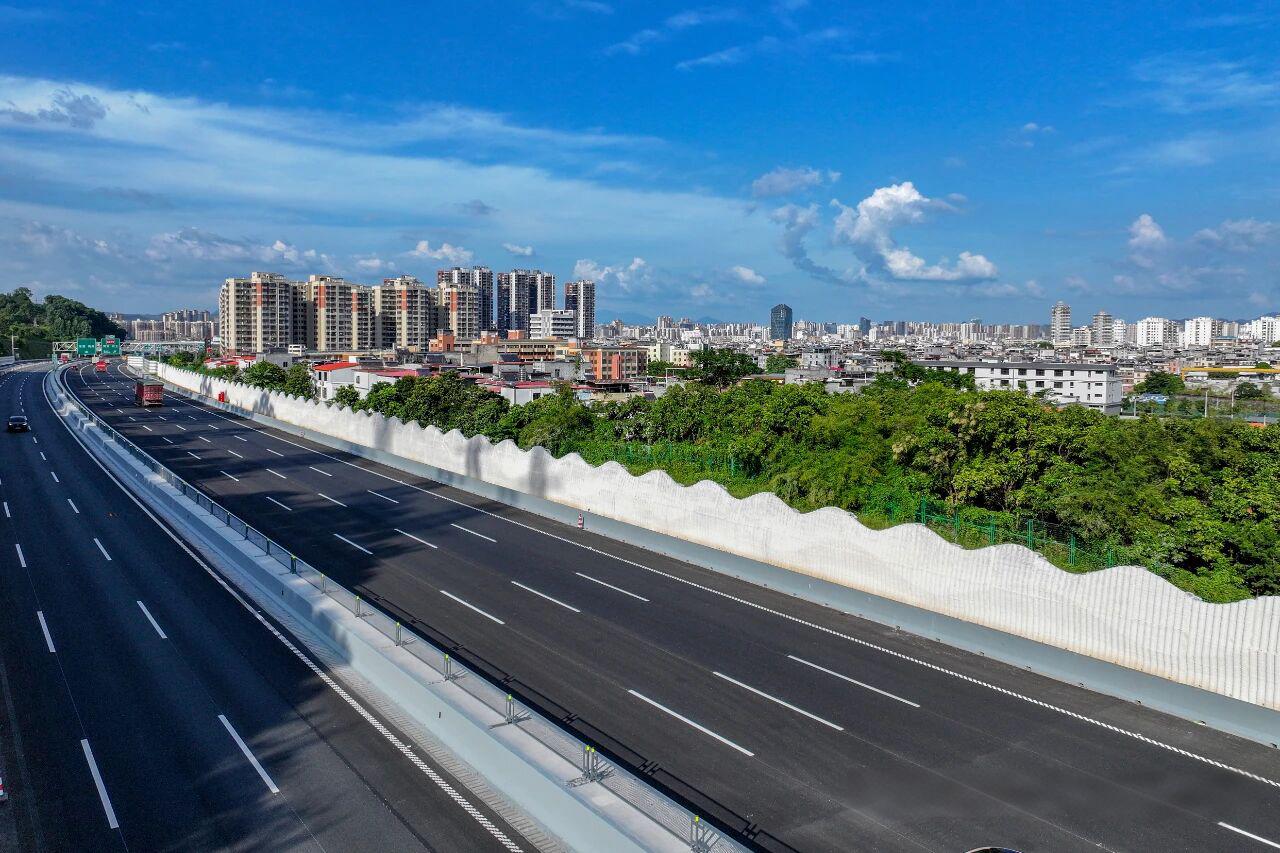
3D-printed sound barrier for the northern section of the Changchun-Shenzhen Expressway (Hehui section) reconstruction and expansion project in Guangdong Province.
Along the Chengbei section of the Changshen Expressway (Hehui section) reconstruction and expansion project, a row of wave-shaped sound barriers along the roadside is eye-catching. This is the first time 3D-printed sound barriers have been used on a Guangdong expressway, providing a smarter and greener solution for roadside noise control.
Project Info
Project Details
In October 2025, a row of wave-shaped sound barriers along the roadside of the Chengbei section of the Changchun-Shenzhen Expressway (Hehui section) reconstruction and expansion project attracted attention. This was the first time 3D-printed sound barriers had been trialed on a Guangdong expressway, providing a smarter and greener solution for roadside noise control. How are sound barriers for reducing traffic noise achieved through 3D printing?
The project actively conducted experimental explorations, innovatively introducing 3D printing technology. Before operation, digital software intelligently disassembled the 3D model of the sound barrier into multiple planar "puzzle pieces," which were then digitally modeled and programmed to generate 3D printing drawings.
Subsequently, the 3D printer stably output concrete material according to the drawing path, stacking and bonding it layer by layer from bottom to top to ultimately form a solid whole. Compared to traditional processes, this technology has advantages such as faster forming, less labor, and better sound absorption, and can also flexibly complete complex curves and patterns. To ensure the "printing" quality, a visual and multi-sensor monitoring system was also deployed on-site, and a virtual model synchronized with the physical printing equipment was constructed using digital twin technology to monitor the printing status in real time.
In terms of design, the sound barrier incorporates local cultural elements of Heyuan, showcasing the dynamic beauty of the landscape and enhancing its visual appeal. Environmentally friendly fluorescent materials will be added later, allowing the sound barrier to emit a soft glow at night, beautifying the nighttime driving environment and improving driving safety.
Project Details
In October 2025, a row of wave-shaped sound barriers along the roadside of the Chengbei section of the Changchun-Shenzhen Expressway (Hehui section) reconstruction and expansion project attracted attention. This was the first time 3D-printed sound barriers had been trialed on a Guangdong expressway, providing a smarter and greener solution for roadside noise control. How are sound barriers for reducing traffic noise achieved through 3D printing?
The project actively conducted experimental explorations, innovatively introducing 3D printing technology. Before operation, digital software intelligently disassembled the 3D model of the sound barrier into multiple planar "puzzle pieces," which were then digitally modeled and programmed to generate 3D printing drawings.
Subsequently, the 3D printer stably output concrete material according to the drawing path, stacking and bonding it layer by layer from bottom to top to ultimately form a solid whole. Compared to traditional processes, this technology has advantages such as faster forming, less labor, and better sound absorption, and can also flexibly complete complex curves and patterns. To ensure the "printing" quality, a visual and multi-sensor monitoring system was also deployed on-site, and a virtual model synchronized with the physical printing equipment was constructed using digital twin technology to monitor the printing status in real time.
In terms of design, the sound barrier incorporates local cultural elements of Heyuan, showcasing the dynamic beauty of the landscape and enhancing its visual appeal. Environmentally friendly fluorescent materials will be added later, allowing the sound barrier to emit a soft glow at night, beautifying the nighttime driving environment and improving driving safety.