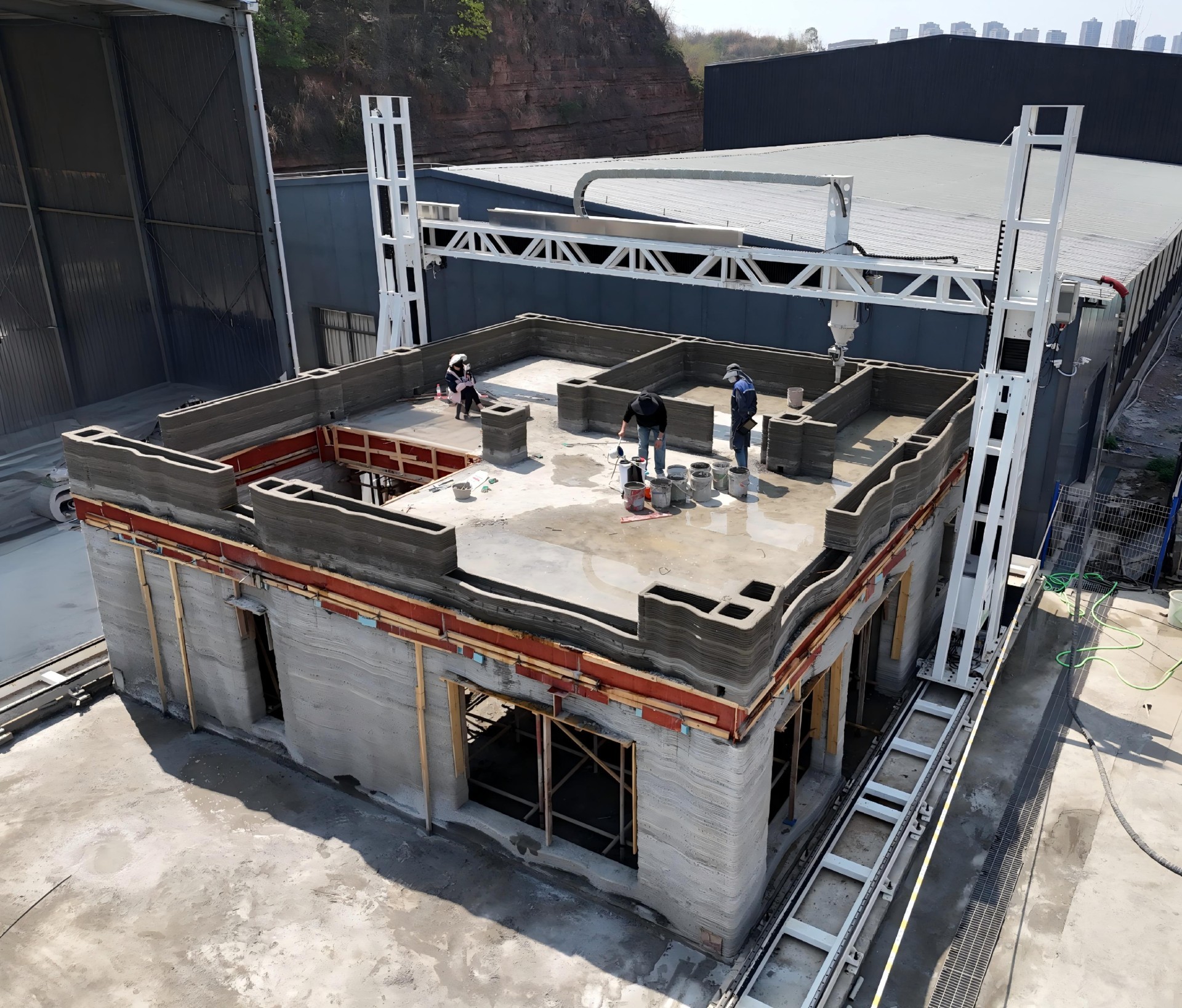
Two-story villa at Lianxin Lake, Three Gorges University, Yichang City, Hubei Province
The 3D-printed villa next to Lianxin Lake at Three Gorges University is the first in-situ 3D-printed two-story building in China. With a total floor area of 220 square meters, printing began in February 2025 and the building was topped out in April, completing the printing process in just 22 days, shortening the construction period by 70% compared to traditional construction methods. The building utilizes the third-generation "Xiaonan 12-meter gantry-type architectural 3D printer," integrating core technologies such as in-situ integrated printing and AI intelligent path planning. The load-bearing columns and walls employ an innovative composite structure process, and green printing materials such as phosphogypsum and construction waste can be used to prepare the printing materials. This not only achieves the goals of lower cost, higher efficiency, more stable quality, and superior precision, but also marks a key breakthrough in the application of 3D printing technology in construction, moving it from the laboratory to engineering applications.
Project Info
Project Details
At our school's 3D printing R&D base in Yichang, Hubei Province, we have successfully built a unique two-story villa. This seemingly ordinary building, covering 110 square meters with a total construction area of approximately 220 square meters, is the first in-situ 3D-printed two-story building in China, marking a new milestone for our team in advancing intelligent construction in the country's building industry.
Unlike traditional construction methods, this villa was printed on-site using our independently developed giant 3D printer, the XNMNOSTER-I10. Under the leadership of Professor Li Yangbo, our team successfully overcame several technical challenges in large-scale architectural 3D printing. Our independently developed third-generation 12-meter gantry-type architectural 3D printer achieves a printing speed of up to 800 millimeters per second, with positioning accuracy controlled within 0.1 millimeters and a printed shape deviation of no more than 2 millimeters.
Previously, large-scale architectural 3D printing often faced industry pain points such as large spacing spans and large cumulative errors. To address this, we innovatively used AI algorithms to plan the printing path, effectively shortening the print head's idle travel time and successfully solving core challenges such as accuracy control, structural continuity, and printing stability. Meanwhile, we innovatively adopted an integrated "printed template + cast-in-place structure" process: during printing, the 3D printer first completes the outer shell of the load-bearing columns, then the steel cage is installed into the hollow part and combined with traditional reinforced concrete pouring techniques to ensure the safety and stability of the core load-bearing structure.
The construction of this two-story villa fully demonstrates the amazing efficiency of 3D printing technology: from the start of printing to the completion of the roof, the entire process takes only 22-30 days, shortening the construction period by about 70% compared to traditional construction methods; the entire construction process requires only 3 team members, reducing manpower requirements by 90% compared to traditional construction methods. During construction, we only need to import the building model into the system, adjust the number of printing layers and the floor height, and click "one-click printing," and the equipment can automatically start the construction work. This high efficiency is mainly due to the continuous operation capability of 3D printing technology—the printer can work day and night, unaffected by light and weather conditions, significantly improving construction efficiency.
In terms of economy and environmental protection, 3D printing technology also performs outstandingly: the overall cost of this two-story villa is reduced to about one-third of that of traditional methods, with a cost of only about 1,000 yuan per square meter. Our gantry-type 3D printer for construction can utilize phosphogypsum and construction waste as raw materials, achieving resource recycling. Furthermore, as an incremental manufacturing technology, 3D printing generates virtually no construction waste, and its high printing precision significantly reduces material waste, making it more environmentally friendly and sustainable than traditional construction methods.
Under Professor Li Yangbo's leadership, we understand that the application potential of this technology extends far beyond the construction field: this gantry-type 3D printer can also print materials such as fiberglass, ceramics, and plastics, covering various construction scenarios including municipal pipelines, drainage facilities, and landscape sculptures. Its potential is even greater in rural revitalization and emergency construction—it can quickly provide temporary housing for affected people when natural disasters damage houses; and it can rapidly build sturdy and durable houses at a lower cost in remote rural areas.
This year, our equipment and technology will be put into practical application in Hubei, Shanghai, Zhejiang, and other regions, bringing technological innovation to the construction industry in more areas. With the promotion and application of this technology across various regions, we will see more intelligent construction projects implemented in the future. Whether in cities, vast rural areas, or the field of emergency construction requiring rapid response, this technology will play a vital role. We firmly believe that as technology matures further, people will no longer be limited to fixed house types when purchasing homes in the future. Instead, they can have their own ideal home through customized design, just like printing a document. The construction industry will also truly move from "manufacturing" to a new stage of "intelligent manufacturing".
Project Details
At our school's 3D printing R&D base in Yichang, Hubei Province, we have successfully built a unique two-story villa. This seemingly ordinary building, covering 110 square meters with a total construction area of approximately 220 square meters, is the first in-situ 3D-printed two-story building in China, marking a new milestone for our team in advancing intelligent construction in the country's building industry.
Unlike traditional construction methods, this villa was printed on-site using our independently developed giant 3D printer, the XNMNOSTER-I10. Under the leadership of Professor Li Yangbo, our team successfully overcame several technical challenges in large-scale architectural 3D printing. Our independently developed third-generation 12-meter gantry-type architectural 3D printer achieves a printing speed of up to 800 millimeters per second, with positioning accuracy controlled within 0.1 millimeters and a printed shape deviation of no more than 2 millimeters.
Previously, large-scale architectural 3D printing often faced industry pain points such as large spacing spans and large cumulative errors. To address this, we innovatively used AI algorithms to plan the printing path, effectively shortening the print head's idle travel time and successfully solving core challenges such as accuracy control, structural continuity, and printing stability. Meanwhile, we innovatively adopted an integrated "printed template + cast-in-place structure" process: during printing, the 3D printer first completes the outer shell of the load-bearing columns, then the steel cage is installed into the hollow part and combined with traditional reinforced concrete pouring techniques to ensure the safety and stability of the core load-bearing structure.
The construction of this two-story villa fully demonstrates the amazing efficiency of 3D printing technology: from the start of printing to the completion of the roof, the entire process takes only 22-30 days, shortening the construction period by about 70% compared to traditional construction methods; the entire construction process requires only 3 team members, reducing manpower requirements by 90% compared to traditional construction methods. During construction, we only need to import the building model into the system, adjust the number of printing layers and the floor height, and click "one-click printing," and the equipment can automatically start the construction work. This high efficiency is mainly due to the continuous operation capability of 3D printing technology—the printer can work day and night, unaffected by light and weather conditions, significantly improving construction efficiency.
In terms of economy and environmental protection, 3D printing technology also performs outstandingly: the overall cost of this two-story villa is reduced to about one-third of that of traditional methods, with a cost of only about 1,000 yuan per square meter. Our gantry-type 3D printer for construction can utilize phosphogypsum and construction waste as raw materials, achieving resource recycling. Furthermore, as an incremental manufacturing technology, 3D printing generates virtually no construction waste, and its high printing precision significantly reduces material waste, making it more environmentally friendly and sustainable than traditional construction methods.
Under Professor Li Yangbo's leadership, we understand that the application potential of this technology extends far beyond the construction field: this gantry-type 3D printer can also print materials such as fiberglass, ceramics, and plastics, covering various construction scenarios including municipal pipelines, drainage facilities, and landscape sculptures. Its potential is even greater in rural revitalization and emergency construction—it can quickly provide temporary housing for affected people when natural disasters damage houses; and it can rapidly build sturdy and durable houses at a lower cost in remote rural areas.
This year, our equipment and technology will be put into practical application in Hubei, Shanghai, Zhejiang, and other regions, bringing technological innovation to the construction industry in more areas. With the promotion and application of this technology across various regions, we will see more intelligent construction projects implemented in the future. Whether in cities, vast rural areas, or the field of emergency construction requiring rapid response, this technology will play a vital role. We firmly believe that as technology matures further, people will no longer be limited to fixed house types when purchasing homes in the future. Instead, they can have their own ideal home through customized design, just like printing a document. The construction industry will also truly move from "manufacturing" to a new stage of "intelligent manufacturing".