XN-MINI 300
Model: MINI 300
XN-MINI 300 is a desktop industrial-grade gantry multi-material 3D printer. It supports fused-granulate fabrication with thermoplastic pellets, clay 3D printing and concrete-mortar 3D printing. With a build volume of 300 × 300 × 300 mm, it is suitable for multi-material research, process validation, education and small-scale production.
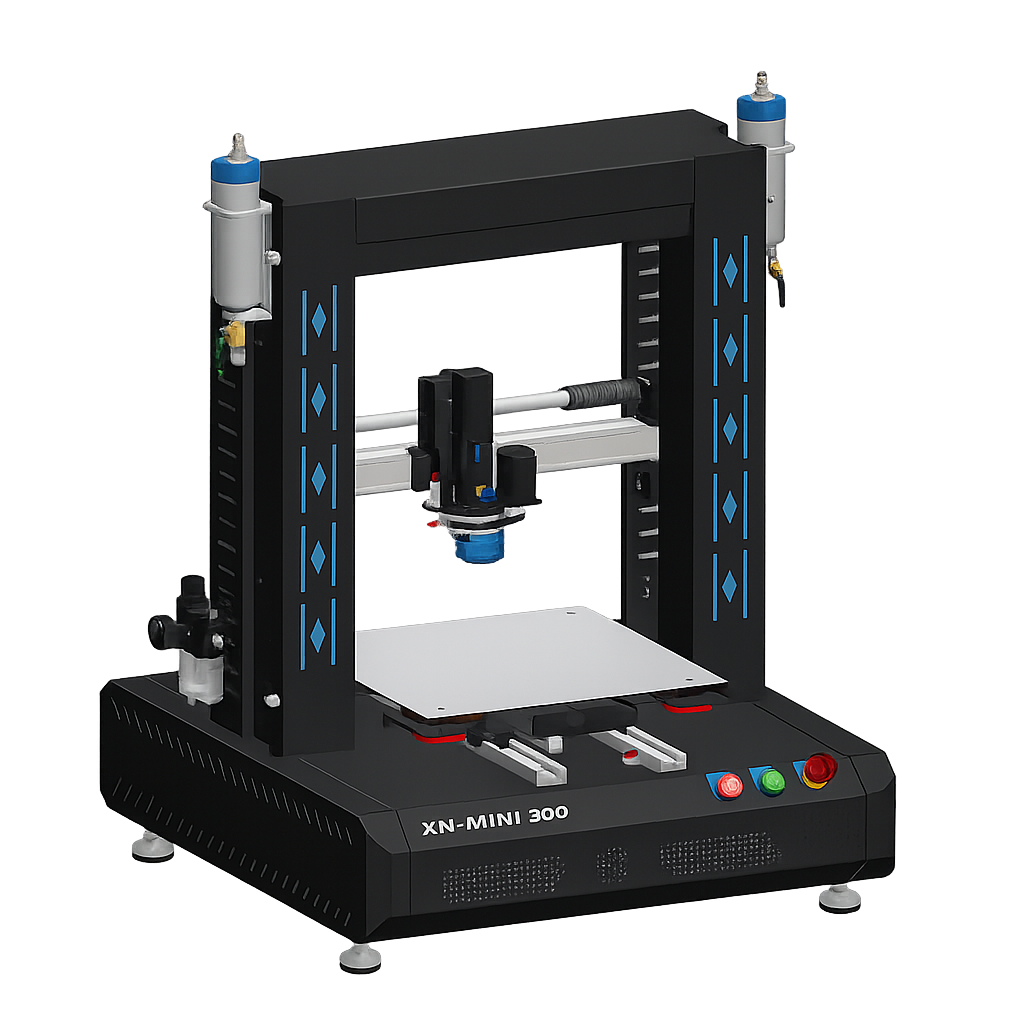
XN-MINI 300
Equipment Details
XN-MINI 300 Desktop Industrial Multi-Material Gantry 3D Printer
XN-MINI 300 is a desktop industrial-grade 3D printer developed for multi-material additive manufacturing, process development, research and education.
The machine features a gantry motion architecture and provides a build volume of 300 × 300 × 300 mm. It supports fused-granulate fabrication with thermoplastic pellets, clay extrusion and concrete-mortar extrusion. By installing the appropriate printing and feeding systems, different materials and processes can be evaluated on the same equipment platform.
Fused-granulate fabrication
Thermoplastic pellets are heated, melted and deposited layer by layer through a pellet-extrusion printing system.
Unlike conventional filament printing, this process directly uses granular feedstock and is suitable for studying thermoplastic materials, modified compounds and pellet-extrusion processes. The supported polymer types depend on the printhead configuration and material-validation results.
Clay 3D printing
With the appropriate clay-printing and feeding system, the machine can extrude clay with suitable flow and plasticity to produce complex surfaces, open structures and customized ceramic forms.
This process is suitable for ceramic design, product prototyping, education and clay additive-manufacturing research. Printed parts may subsequently be dried, finished and fired according to the selected material and process.
Concrete-mortar 3D printing
The machine supports the extrusion of small concrete-mortar components and can be used to evaluate material formulations, extrusion behavior, interlayer bonding and printing toolpaths.
Once a toolpath has been generated from a digital model, the feeding and extrusion system deposits the mortar layer by layer to create architectural models, landscape prototypes, non-standard components and material test specimens.
Desktop industrial gantry platform
Its compact format makes the machine suitable for laboratories, research centers, design studios and educational facilities. The gantry structure provides a clearly defined working area and a common motion platform for multiple printing processes.
Digital multi-material manufacturing
XN-MINI 300 combines thermoplastic-pellet printing and paste-material printing on one machine platform. It enables users to compare materials, toolpaths and process parameters for material development and manufacturing-process validation.
Typical applications
- Fused-granulate fabrication research
- Clay and ceramic-form production
- Concrete-mortar formulation and printability testing
- Architectural models and landscape prototypes
- Small product prototypes and complex forms
- Additive-manufacturing education and research
- Multi-material 3D printing development
Each material requires a compatible printhead, feeding system and process configuration. Printing speed, layer height, accuracy and forming quality depend on material properties, environmental conditions and process settings.